
Empagliflozin
An independent literature analysis examining the empagliflozin evidence base, regulatory framing, and subsequent published literature. Part of the Narrative Friction Series, it considers where the evolving record may complicate, qualify, or sit in tension with the established narrative.
Executive Synthesis
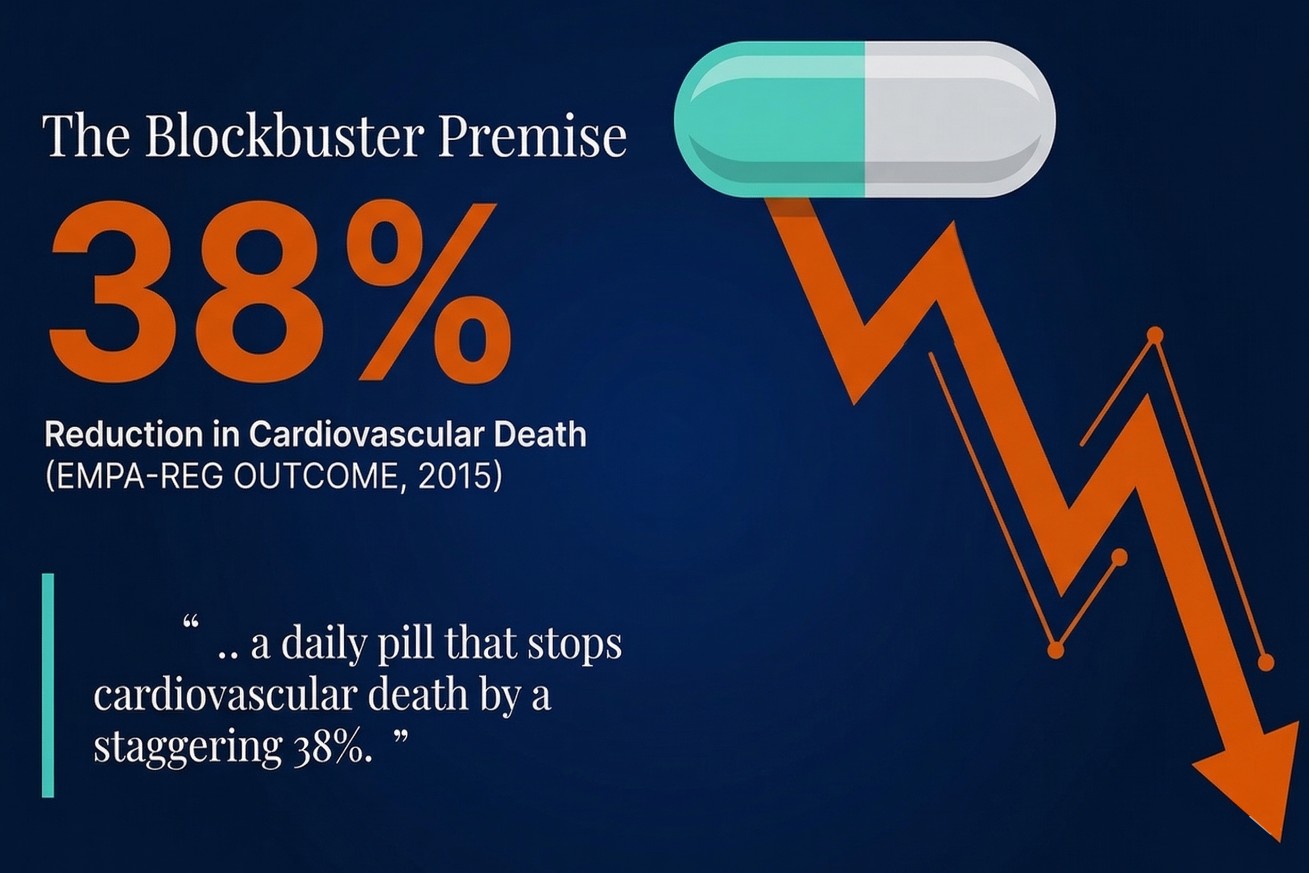
The EMPA-REG OUTCOME trial produced a striking headline: a 38% reduction in cardiovascular mortality. However, the underlying regulatory review revealed profound complications: up to 40% of cardiovascular deaths were non-assessable, and removing them eliminated the statistical signal altogether! The 10mg and 25mg doses produced nearly identical curves, defying biological expectations.
This report does not attempt an exposé. It attempts to provide some insight into why the FDA arrived at what seems an astonishing 12-11 advisory committee split. This means half of the medical experts voted against approving the mortality benefit claim.... despite the impressive 38% figure. The report explores the extent to which the subsequent published literature narrowed, reinforced, or complicated the original confident narrative. It brings together and attempts to simplify issues otherwise highly fragmented across publications and commentaries.
Some Observations from the Empa-Reg Outcome Trial
Five observations which split the FDA down the middle on whether or not to approve the indication.
The survival curves separated within weeks: seemingly biologically implausible for an atherosclerosis mechanism.
Up to 40% of cardiovascular deaths were non-assessable: they may not have been cardiovascular deaths at all. Removing them eliminated the statistical signal.
The trial population in Europe and North America (making up 61% of the total trial population) showed no mortality benefit.
The 10mg and 25mg doses produced near-identical outcome curves: no dose-response.
Post-trial follow-ups failed to confirm the headline mortality claim.

Preview the Report
Inside the Empagliflozin Report ...

Why This Report Matters if you're in any of the following functions
Drug Safety / Pharmacovigilance
For safety teams, narrative friction matters when a widely accepted clinical story sits uneasily beside the broader record. This briefing may help sharpen internal review of cardiovascular-risk interpretation, signal context, and whether the accepted consensus has always rested on a more contested and complex evidentiary foundation than is commonly assumed.
Regulatory Affairs
For regulatory teams, the relevance lies in how trial claims, label history, and subsequent literature interact over time. It also highlights how initial regulatory framing can confer lasting authority on a clinical claim, even where the evidentiary position was contested and complex from the outset. This briefing may inform a more nuanced view of whether the established regulatory narrative remains fully supported, or whether aspects of it merit closer contextualization. It also invites reflection on how majority-based regulatory decisions can, over time, lend policy weight to scientific positions that remain more nuanced than their later treatment may suggest.
Legal / Compliance
For legal and compliance functions, narrative friction can become material when public claims, authored literature, and regulatory positioning acquire a clarity or certainty that the underlying evidentiary record did not fully support, even at the outset. This briefing may help identify where the record has long been more qualified or complex than the prevailing narrative suggests, and where communications, training, or internal governance may require greater precision.
Medical Affairs
For Medical Affairs, the value lies in understanding where the evidence base has become more layered than the headline narrative. This briefing may support more careful scientific exchange, stronger contextualization of the literature, and more balanced responses to difficult or off-script questions from clinicians and other stakeholders.
Internal Governance
For governance, risk, and senior review functions, the issue is not simply whether a claim was once supportable, but whether it remains straightforward in light of the full downstream record. This briefing may help leadership teams assess whether internal positioning, oversight, and risk interpretation should be revisited with greater nuance.
Payors
For payors and reimbursement decision-makers, narrative friction matters when formulary positioning, value assumptions, or reimbursement logic rest on a clinical narrative that may have carried more authority than the underlying evidentiary position warranted from the beginning. This briefing may support a more discriminating view of evidentiary strength, decision uncertainty, and the resilience of the claims underpinning coverage logic.
Ethics Committees
For ethics committees and research oversight bodies, the relevance lies in how evidence is framed, interpreted, and carried forward into later decision-making. This briefing may assist in evaluating whether the balance between signal, uncertainty, and representation of the record remains sufficiently transparent for responsible oversight.
Regulators
For regulators, narrative friction is particularly relevant when nuance and complexity in the evidence are lost as a split decision hardens into settled public and professional discourse and becomes embedded in clinical guidelines. This briefing may help clarify how such situations develop: where the evidentiary record remains robust, where it becomes more ambiguous, and where greater precision at the time of approval may be warranted to help shape the broader clinical narratives that subsequently emerge.
Access the Full report...
Purchase a single-user licence to the report or unlock multi-user access for up to 5 persons.
License Terms
Single User Licence
Multi-User Licence
Licenced access for up to 5 named users
Displayed prices are indicative and shown in your local currency estimate. Final checkout is processed in ZAR via PayFast and may vary slightly with live exchange rates.
Next Edition:
Alzheimer's Disease
Next month’s Narrative Friction report focuses on Alzheimer’s disease, exploring a significant pharmaceutical narrative and the areas in which the evidence and regulatory record invite closer review.
Coming June 2026
Narrative Friction Series
Loading...